

In this article, we’ll explore how loss aversion and premature exits can shrink your average winning trade, distort your reward-to-risk ratio, and undermine your mathematical expectancy. Using four real trading examples from my Post-Earnings Momentum (PEM) strategy, I’ll demonstrate how emotionally driven exits cost me approximately 76.3% of my potential net profits, despite maintaining an identical 75% win rate. You’ll also learn how predefined exit criteria, backtesting, and trading discipline can help protect your statistical edge.

Cut your losses and let your winners run! – It’s literally one of the oldest clichés in stock trading. But understanding it is considerably easier than putting it into practice.
In my experience, trading psychology has been by far the hardest part of learning how to day trade post-earnings momentum. Mastering your emotions and overcoming behavioral biases takes an enormous amount of time, patience, and effort.
Even after years of trading, I still occasionally cut winning trades short out of fear of giving back unrealized profits. And I know that sounds like it can be a good idea, especially when it prevents a winning trade from turning into a losing trade.
But the problem?
This behavior can shrink your average winner, skew your risk-to-reward ratio, and turn an otherwise profitable trading strategy into a losing one.
In this article, we’ll explore the psychology and mathematics behind this costly habit, AND explore a few real examples from my own trading.
PTJ Recommended Reading
Master Your Trading Psychology
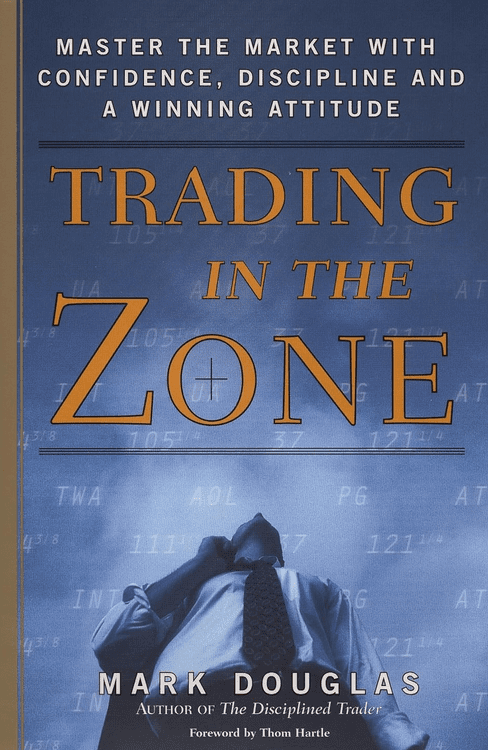
Mark Douglas’s Trading in the Zone is widely regarded as one of the best books ever written on trading psychology. It’s essential reading for traders struggling with fear, loss aversion, emotional decision-making, and consistently executing their trading strategies.
Check Price on Amazon →Affiliate disclosure: As an Amazon Associate, I earn from qualifying purchases at no additional cost to you.
Quick Answer: How Do You Actually Cut Losers And Let Winners Run?
The key to cutting losses and letting winners run is to establish predefined, backtested exit criteria and stick to them regardless of how you feel during a trade. For example, with a 50% win rate, an average winner of 8% and an average loser of 5% produces a positive expectancy of 1.5% per trade before trading costs. However, prematurely cutting your average winner to 3% turns that expectancy negative (-1%). Use consistent position sizes, accept fluctuations in unrealized profits, and journal your execution mistakes to gradually improve your trading discipline.
What Is Loss Aversion in Trading?
Loss aversion is a psychological bias where the emotional pain of losing money outweighs the satisfaction of making an equivalent amount.
In trading, this can contribute to what’s known as the disposition effect, which is the tendency to hold losing trades too long while exiting winning trades too soon.
Rather than making decisions based on statistical probabilities and predefined exit criteria, traders make decisions based on their desire to avoid emotional discomfort.
Unfortunately, this can significantly undermine an otherwise profitable trading strategy.
Two different trades. One psychological bias.
“It’ll come back. I don’t want to take the loss.”
“I’d better sell before I give back my profits.”
Same setups. Same position sizes. Different execution.
Illustrative example using $1,000 positions, before trading costs. Source: Paper Trading Journal.
How Cutting Winners Too Early Can Destroy Your Trading Edge
A profitable trading strategy isn’t necessarily one that wins more often than it loses. It’s one that has a positive mathematical expectancy, meaning that, over a large sample of trades, it generates more money than it loses.
Nobody LOOOOOOOVES math. But if you want to learn how to trade profitably, you’ll need to dip your feet in and learn the basics of trading math.
Expectancy is calculated using three variables: your win rate, average winning trade, and average losing trade.
Trading expectancy = (Win rate × Average win) − (Loss rate × Average loss)
To illustrate why cutting winners too early is problematic, let’s compare two hypothetical traders who execute the exact same 100 trades using $1,000 positions.
| Trading Metric | Trader A | Trader B |
|---|---|---|
| Total trades | 100 | 100 |
| Win rate | 50% | 50% |
| Average winner | +8% | +3% |
| Average loser | -5% | -5% |
| Reward-to-risk ratio | 1.6:1 | 0.6:1 |
| Expectancy per trade | +$15 | -$10 |
| Total P/L | +$1,500 | -$1,000 |
Simply from cutting winning trades too early.
Hypothetical results using fixed $1,000 positions, before trading costs. Source: Paper Trading Journal.
Despite having identical win rates and average losses, there’s a staggering $2,500 difference in profitability between these two traders. And yet, the only variable we’ve changed is the size of their average winning trade.
And that’s precisely why loss aversion can be so detrimental to your trading performance.
By repeatedly taking profits prematurely, you can unintentionally destroy your statistical edge and turn a positive equity curve into a negative one — without ever changing your entry strategy.
Real Trading Examples: How I Sabotaged My Own Trading Expectancy
Unfortunately, I’m not immune to loss aversion either!
Despite having backtested my Post-Earnings Momentum (PEM) trading strategy across hundreds of setups, I still occasionally find myself exiting winning trades prematurely out of fear of giving back profits.
Below are several real examples from my recent trading that illustrate how emotionally driven exits can shrink the size of your average winner, negatively impact reward-to-risk ratio, and ultimately sabotage an otherwise profitable statistical edge.
Example #1: How Impatience Reduced My DLTR Profits by 85%
Dollar Tree ($DLTR) presented a strong, almost textbook-perfect PEM setup.
My strategy generally calls for holding a trade right up until the end-of-day unless price hits a -15% stop loss. However, in this case, I exited prematurely simply because I felt the stock wasn’t moving enough.

I ended up walking away with a measly +0.2% gain ($2), whereas holding until my planned end-of-day exit could have netted me closer to +1.38% ($13.80).
Neither outcome represents a particularly impressive gain, but that’s not the point. By exiting prematurely, I reduced my potential profit by roughly 85%.
Repeatedly making these emotionally driven decisions significantly shrank the size of my average winner and undermines my strategy’s mathematical expectancy.
Example #2: How an Emotional Exit Made My DKS Loss Four Times Bigger
Dick’s Sporting Goods ($DKS) presented another bullish PEM setup following a +15.5% hourly earnings candle.
However, I allowed a minor pullback to shake me out of my position, resulting in a -5.5% loss ($55). Had I simply followed my predefined exit criteria and held until EOD, I could have walked away with a considerably smaller -1.28% loss ($12.80).

This illustrates the other side of emotionally driven trade management.
Not only can premature exits shrink the size of your average winner, but they can also unnecessarily inflate the size of your average loser. Both behaviors negatively impact your reward-to-risk ratio and overall trading expectancy.
The lesson?
Cutting losses doesn’t mean exiting whenever a trade makes you uncomfortable. It means respecting your predefined, backtested exit criteria, and allowing trades room and time to breathe.
Example #3: How Fear of Giving Back Profits Cost Me Nearly Half My HPE Gains
Hewlett Packard Enterprise ($HPE) presented a strong bearish PEM setup. In my defense, I exited my short position after the stock formed a bullish hammer, which can signal a potential reversal following a downtrend.
However, the price never came remotely close to threatening my entry price. I could have even moved my stop-loss to breakeven and let the trade run without being stopped out.
Instead, I settled for a respectable +6.6% gain, whereas following my original trading plan could have netted me more than +12%.

While +6.6% is certainly nothing to complain about, large winning trades are precisely what help offset smaller losing trades and drive positive mathematical expectancy.
By consistently interfering with my trades, and cutting large winners short, I’m effectively reducing the profitability of my own trading strategy.
Example #4: How Taking Profits Too Early Cost Me an Extra 5% on KSS
Kohl’s ($KSS) presented another strong bullish PEM setup. After entering at the close of the hourly earnings candle, I prematurely exited my position for a +3.6% gain ($36).
However, had I followed my original trading plan and held until EOD, I could have captured approximately +8.6% ($86).

That’s an additional +5% or $50 in potential profit on a single $1,000 position, without changing my entry or increasing my initial risk.
Again, the problem isn’t that I made a bad trade or lost money. It’s that I unnecessarily limited the size of a winning trade.
When repeated consistently across dozens or hundreds of trades, this seemingly harmless habit can have a devastating impact on a trading strategy’s overall profitability.
Obviously, four trades aren’t a statistically significant sample, and premature exits won’t always produce worse outcomes. But these examples beautifully illustrate the negative impact of deviating from your trading strategy.
4 trades. Identical entries. Different exit decisions.
| Trade / Metric | Actual | Rule-Based |
|---|---|---|
| DLTR | +$2.00 | +$13.80 |
| DKS | -$55.00 | -$12.80 |
| HPE | +$66.00 | +$120.00 |
| KSS | +$36.00 | +$86.00 |
| Total P/L | +$49.00 | +$207.00 |
| Impact on Trading Performance | ||
| Win rate | 75% | 75% |
| Average winner | $34.67 | $73.27 |
| Average loser | $55.00 | $12.80 |
| Reward-to-risk | 0.63:1 | 5.72:1 |
| Average P/L per trade | +$12.25 | +$51.75 |
76.3% of potential net profits sacrificed without changing a single entry, position size, or the overall win rate.
Source: Paper Trading Journal, November 24, 2026. Results normalized to $1,000 positions before trading costs. Rule-based returns are hypothetical estimates, using +12% for HPE and +8.6% for KSS. Four trades are not statistically significant.
Despite maintaining an identical 75% win rate, my emotionally driven exits reduced my average winning trade by approximately 53% and more than quadrupled the size of my average loser.
Consequently, I walked away with just $49 instead of a potential $207. That’s $158 in potential profits sacrificed across just four trades — not because of poor stock selection or bad entries, but because I failed to follow my own trading rules.
PTJ Recommended Reading
Master Your Trading Psychology
Mark Douglas’s Trading in the Zone is widely regarded as one of the best books ever written on trading psychology. It’s essential reading for traders struggling with fear, loss aversion, emotional decision-making, and consistently executing their trading strategies.
Check Price on Amazon →Affiliate disclosure: As an Amazon Associate, I earn from qualifying purchases at no additional cost to you.
The Bottom Line – Cutting Losers & Letting Winners Run
Cutting your losses and letting your winners run isn’t about exiting every losing trade immediately or holding winning trades indefinitely. It’s about consistently following predefined, statistically tested exit criteria.
As my own trading examples demonstrate, even a profitable trading strategy can be undermined by emotionally driven decisions that shrink your average winner and inflate your average loser.
Ultimately, there’s a BIG difference between managing risk and managing emotional discomfort.
The goal isn’t to eliminate discomfort from trading. It’s to stop letting discomfort dictate your trading decisions.
If you want to go deeper:
- Explore the Trading Statistics Hub to understand how different sectors behave across market cycles
- Study real setups inside the Trade Reviews section
- Learn the framework behind high-probability setups in the Post-Earnings Momentum Strategy
This is how you turn raw market data into repeatable trading edge.
More Trading Statistics…


Frequently Asked Questions
What does it mean to cut your losses and let your winners run?
Cutting losses and letting winners run means limiting the size of losing trades while allowing winning trades sufficient room to develop. For example, with a 50% win rate, an average winner of 8% and an average loser of 5% produces a positive mathematical expectancy of 1.5% per trade before trading costs.
What is loss aversion in stock trading?
Loss aversion is a psychological bias where losses feel more painful than equivalent gains feel rewarding. For example, a trader might experience more emotional discomfort from losing $100 than satisfaction from making $100. This can contribute to holding losing trades too long or prematurely closing winning positions.
Why do traders sell winning stocks too early?
Traders often sell winning positions prematurely because they’re afraid of giving back unrealized profits. However, reducing your average winning trade from 8% to 3%, while maintaining an average loss of 5% and a 50% win rate, turns a positive expectancy of 1.5% into a negative expectancy of -1% per trade.
How do you calculate trading expectancy?
Trading expectancy is calculated using the following formula:
Expectancy = (Win rate × Average win) − (Loss rate × Average loss)
For example, a trader with a 60% win rate, an average winner of $80, and an average loser of $50 has a positive expectancy of $28 per trade before trading costs.
Can you be profitable with a win rate below 50%?
Absolutely! A trader with a 40% win rate, an average winner of $100, and an average loser of $50 has a positive expectancy of $10 per trade. Over 100 trades, that translates into an expected profit of $1,000 before trading costs.
What is a good reward-to-risk ratio for day trading?
There is no universally optimal reward-to-risk ratio. A 2:1 reward-to-risk ratio requires a win rate above 33.3% to be profitable before trading costs, whereas a 1:1 ratio requires a win rate above 50%. The ideal ratio depends on your strategy’s historical performance.
When should you exit a winning trade?
You should exit a winning trade when your predefined exit criteria are met, whether that’s a profit target, trailing stop-loss, technical signal, or time-based exit. Taking a 3% profit simply because you’re afraid of losing it can undermine a strategy designed to capture larger average gains.
How can you overcome loss aversion in trading?
Backtest your strategy across a substantial sample of trades, maintain consistent position sizes, establish objective exit criteria, and journal deviations from your trading rules. Comparing actual returns against rule-based returns can help quantify the financial cost of emotionally driven decisions.
Is it always better to let winning trades run?
No. Holding winning trades longer doesn’t guarantee larger profits. A position that’s up 8% could eventually close at a 2% loss. The objective isn’t to maximize the profit on every individual trade, but to maximize mathematical expectancy across a large sample of trades.


Leave a Reply